Deck, circulation and daily use
Keep a continuous route from the house to the pool, leave usable deck space for entry and seating, and test whether doors, furniture and the pool cover can operate without blocking that route.
 gardmi 🇺🇸
Garden site planner
gardmi 🇺🇸
Garden site planner
 Ready constructions — not an empty rectangle
Design a swimming pool for your plot right in the browser. Pick a ready construction — skimmer, overflow, infinity, Roman-end, lap or plunge pool — and gardmi draws the shell with its bottom profile and coping, places the skimmers, return inlets, lights and the entry steps, and computes the water volume, the wetted area for the finish, the coping metres and the pump flow. Even if this is your first pool, the editor keeps every alternative measurable.
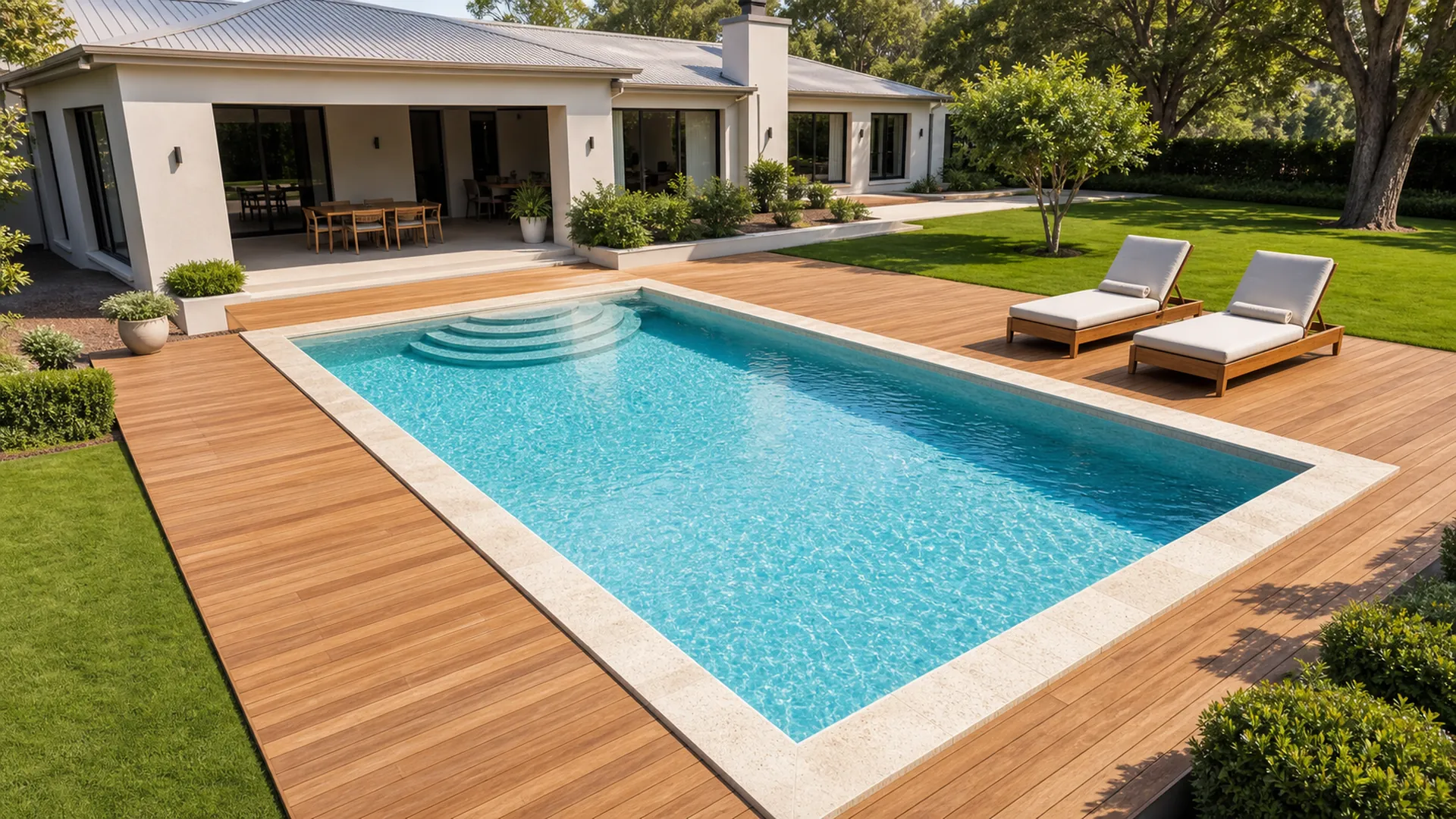
A pool shape can look good by itself and still fail in the backyard. Draw the house, property line, doors, paths and fixed trees first, then compare complete pool-and-yard layouts at the same scale.
Keep a continuous route from the house to the pool, leave usable deck space for entry and seating, and test whether doors, furniture and the pool cover can operate without blocking that route.
Reserve a realistic route for excavation and delivery before fixing the shell location. Mark the equipment area and pipe route as questions for the pool contractor instead of hiding them outside the drawing.
Compare morning and afternoon shade, views from the house and neighbouring windows, and where screening could go. Treat an image or map as context; verify dimensions and boundaries independently.
Show where deck runoff can go and reserve space for the barrier, gate and safety cover required in your location. Setbacks, drainage, electrical safety and permits vary: confirm them before choosing a final layout.
The water-handling system is the first decision about a pool: it sets the water level, whether there is a perimeter gutter and a surge tank, and half of the budget.
The water sits 10–15 cm below the coping and is drawn off through skimmers set into the wall — one per about 25 m² of surface. The simplest and cheapest scheme: no gutter, no surge tank, a compact plant room. This is what most private pools are.
The water is level with the deck and spills into a gutter around the whole perimeter — a Finnish gutter with a grate or a hidden Wiesbaden slot. The surface film goes away with the water; a surge tank of 10–12% of the volume takes the displaced water when swimmers get in.
Only one visible edge overflows: the water runs over a wall into a catch basin below, and from a lounger the surface merges with the horizon. The other sides are an ordinary coping — so the shell is cheaper than a full overflow one.
A lap pool is a 25 m lane with flat 1.8 m depth; a plunge pool is 2×4 m to cool down in; a spa is a small round bowl with hydromassage jets and a bench. Each is a preset with the right depth, fittings and finish already set.
The shell is not a rectangle with water — it is a shape, a bottom profile and a construction, and all three change the price.
Rectangle, rounded, oval, a Roman semicircular end, an L-shape with a lounge pocket or a freeform bean. Pick one from a preset and then drag the vertices — every shape stays fully editable, with edge lengths and angles shown as you draw.
Flat, an even slope, a shallow zone with a break into a deep one, or a beach entry going down from zero. The profile is what decides the real water volume — and gardmi integrates the depth along it instead of multiplying by the deepest point.
Reinforced concrete gives any shape and any finish; concrete blocks are cheaper but keep the walls straight; a one-piece composite shell arrives ready with gelcoat; a panel kit is assembled fast under a liner. The choice also limits the finish — gardmi keeps impossible pairs out.
From the shell and its depth the editor derives the excavation volume with an allowance around the perimeter, and the concrete volume of the walls and the floor slab — the two numbers a contractor asks for first.
Water is clear — the colour of a pool is the finish seen through it. That is why choosing a finish in gardmi changes the water colour on the plan and in 3D at once.
A welded 1.5 mm membrane: the cheapest and fastest option, forgives an imperfect shell and is replaceable in a week. Service life around 10 years, which is why it dominates private pools.
The durable classic, and the standard for an overflow pool: mosaic follows curved walls, porcelain tile suits straight ones. Demands a truly level shell and careful grouting, and costs several times a liner.
A seamless polymer-cement surface in a sand or grey tone gives the modern, natural look; classic plaster (marbelite) is the traditional cheaper relative. Both are applied over a concrete shell only.
The stone that caps the wall: travertine, granite, sandstone or porcelain, usually 30–35 cm wide. A bullnose edge is kindest to hands, a square edge reads modern, an overhang with a drip groove keeps water off the wall — and on an overflow pool a grate takes its place.
Everything that sits in the pool wall is a separate object in gardmi: click a card, click the wall, drag it along the shell. Picking a preset places the mandatory ones for you, in the numbers your shell needs.
Skimmers and the main drain take water out, return inlets push it back — always on the opposite wall, so the flow crosses the whole pool. One skimmer per ~25 m², inlets sized for ~5 m³/h each.
Underwater lights — about one per 12 m² — plus a counter-current unit for swimming in place, hydromassage jets, a waterfall over the coping and a vacuum point for the cleaner.
Roman steps in a semicircle, corner steps, straight full-width steps, a beach entry sloping from zero, an underwater bench, a stainless ladder and a handrail. Steps cut into the water and are subtracted from the volume.
A full turnover of the water in 6 hours for a skimmer pool and 4 for an overflow one gives the pump flow in m³/h — gardmi shows it next to the volume, along with the surge tank size for overflow schemes.
Import the plot by cadastral number or trace it over a satellite image, then put the house in place. Gardmi draws a planning setback around the pool and highlights a crossing; replace that starting assumption with the distance required by your survey, local rules and permit review.
One click on a preset card sets the edge system, the shell, the finish, the coping and the bottom profile at once — and places the standard skimmers, inlets, lights and an entry in the numbers your size needs.
Drag the vertices, set the deep and shallow ends and where the bottom breaks, then add a counter-current unit, a waterfall or a handrail. The volume, the wetted area and the pump flow update as you drag.
Switch to 3D and walk around the pool — the shell, the bottom slope, the coping and the steps are all really built. The finish, the concrete and the coping turn into a cost estimate in your currency, and the plan exports to PNG or PDF.
A separate calculator asks you for numbers you do not have yet. Here the numbers come out of the drawing — change the shell and every figure follows.
Water surface times the AVERAGE depth over your bottom profile — not the deepest point, which is the classic way to over-order chemicals and undersize nothing but the budget.
Bottom plus walls — the number the liner, mosaic or microcement is actually bought by. For a 3×6 m pool it is more than twice the water surface.
The perimeter gives the coping run, the wall thickness of the chosen construction gives the concrete volume, and the shell with its depth gives the excavation.
Turnover in 6 hours (skimmer) or 4 hours (overflow) gives m³/h; the surface gives the skimmer and light counts; an overflow scheme adds a surge tank of about 12% of the volume.
Volume is the water surface area times the AVERAGE depth, not the deepest point. With a shallow and a deep zone the average sits between them: a 3×6 m pool going from 1.2 to 1.5 m holds about 24 m³, not 27. gardmi integrates the depth over the bottom profile you set and shows the volume live while you drag the shell.
In a skimmer pool the water sits 10–15 cm below the coping and is taken through skimmers in the wall — simpler and cheaper. In an overflow pool the water is level with the deck and spills into a perimeter gutter and a surge tank of 10–12% of the volume — a mirror surface and better skimming, but a technical room and a bigger budget. gardmi builds both, plus the infinity variant where only one visible edge overflows.
A PVC liner is the cheapest and fastest and forgives an imperfect shell; glass mosaic and porcelain tile are the durable classic and the standard for overflow pools; microcement gives a seamless modern surface; a composite shell always comes with gelcoat. The material is bought by WETTED area — bottom plus walls — which is far more than the water surface, and gardmi counts it for you.
Usual practice: one skimmer per ~25 m² of surface, one underwater light per ~12 m², and enough return inlets to pass the filtration flow at ~5 m³/h each. The flow itself follows from a full turnover in 6 hours for a skimmer pool and 4 for an overflow one. gardmi computes all four numbers from your shell and places the fittings when you pick a preset.
Coping is the stone capping the pool wall that finishes the joint between the water and the deck. Typical width is 30–35 cm; a bullnose front edge is safest for hands, a square edge reads modern, an overhang with a drip groove keeps water off the wall. On an overflow pool the gutter grate takes its place. gardmi counts coping by the shell perimeter.
There is no universal distance. The legal boundary, easements, local zoning or building rules, safety barriers, drainage and equipment access can all change the layout. Gardmi draws a planning setback and highlights a crossing, but use the distance required for your property and permit review.
No. Gardmi is for comparing a measured backyard layout, shell options and preliminary quantities. Before construction, verify the property survey, buried utilities, soil and groundwater, drainage, structural and hydraulic design, electrical safety, barriers, equipment specifications, permits and local rules with the relevant qualified professionals and authorities.
gardmi is a free online planner. The volumes, equipment counts and setbacks here are general guidance — check them against your local rules and the specs of the equipment you actually buy.