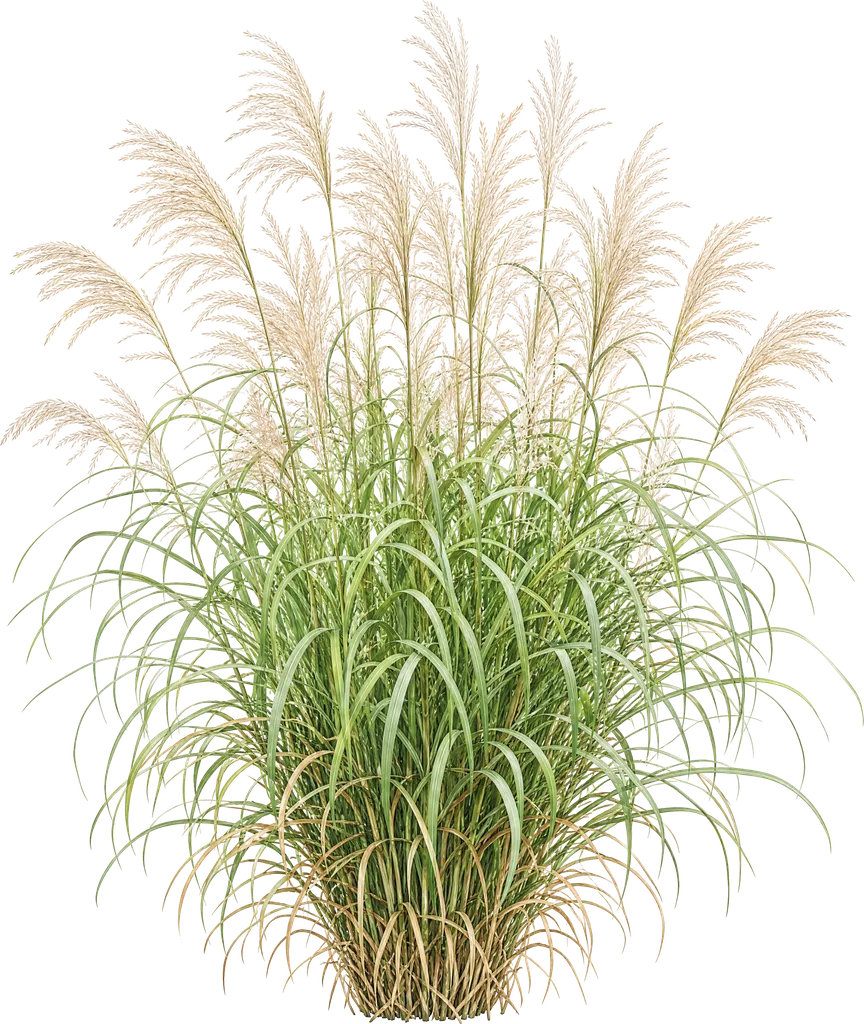
Chinese silver grass (Miscanthus sinensis)
Miscanthus sinensis
Chinese silver grass (Miscanthus sinensis) is a clump-forming perennial ornamental grass. Cultivars vary widely, and the species is invasive or restricted in some North American locations, so verify the exact plant and local status before planting.
Chinese silver grass: height, care and garden planning
Miscanthus sinensis, also called Chinese silvergrass or Japanese silver grass, is a deciduous, clump-forming perennial grass native to Asia. Named cultivars differ greatly in height, width, flowering and seed production, so identify the exact plant before using a catalog dimension.
- How tall does Chinese silver grass grow?
- The species and its cultivars vary widely. NC State Extension gives 4–12 ft tall and 4–6 ft wide; Gardmi uses 1.2–2.5 m tall and about 1.5 m wide as an editable early-planning envelope, not a guaranteed cultivar size.
- Where should Miscanthus sinensis be planted?
- If it is permitted and appropriate locally, compare a sunny site and well-drained soil with the mature size of the named cultivar. Keep access for spring cutback and do not treat Gardmi's drawn root zone as a biological or legal setback.
- When should Chinese silver grass be cut back?
- Leave the dry stems only where they are safe and useful for winter structure, then cut them back in early spring before new growth starts. Follow local fire-safety advice because dry foliage is combustible.
- Is Miscanthus sinensis invasive?
- It is nonnative in North America and is invasive or restricted in some places. Check current state and local invasive-plant lists before buying or planting it; where it is listed, choose a recommended noninvasive alternative instead.
- Is hybrid silver grass the same plant?
- Not necessarily. The hybrid Miscanthus × giganteus involves M. sinensis and another species, while many nursery plants are named cultivars of M. sinensis. Confirm the complete botanical and cultivar name, mature size and seed behavior rather than treating these labels as interchangeable.
Sources: NC State Extension — Chinese silver grass for size, habit, site conditions and North Carolina status; US Forest Service — Miscanthus sinensis for North American distribution, seed spread and regional invasive concern; Kew Plants of the World Online for the accepted name and native range.
Planning parameters
Use these values as a practical planning envelope: they describe the adult plant, not the young seedling.
- Adult height
- 1.2-2.5 m
- Crown diameter
- 1.5 m
- Root zone
- 1.2 m
- Root type
- Rhizomatous, clump-forming perennial; the drawn root zone is an editable planning envelope, not a measured biological boundary.
- Recommended setback
- Plan from the named cultivar's mature width and keep access for spring cutback; verify local boundary and invasive-plant rules separately.
- Growth rate
- Fast
- Hardiness
- USDA zones 5-9
- Crown density
- Medium
Site requirements
These conditions decide whether the plant will establish well after planting.
- Light
- sun
- Watering
- medium
- Soil type
- fertile drained soil
- Drainage
- Adaptable, but use well-drained soil and avoid prolonged waterlogging.
- Soil pH
- Adaptable to a range of soils; confirm the selected cultivar and local site conditions.
Root system and placement
Gardmi's roughly 1.2 m root-zone diameter is a planning aid, not a root limit or legal setback.
Garden role and season
These fields help choose the plant by composition, privacy, flowering and year-round value.
- Form
- Clump-forming perennial grass
- Foliage
- Arching deciduous blades; color and markings vary by cultivar
- Season
- Summer growth, late-season plumes and winter structure
- Bloom
- Late summer to fall, depending on climate and cultivar
- Fruit
- Wind-dispersed seed; seed production varies by cultivar and location
- Garden use
- Only where locally appropriate: specimen, screen or border grass sized to the named cultivar.
Care and risks
This is the practical part for future maintenance and safe placement on the plot.
- Maintenance
- Water while establishing and preserve safe access around the mature clump for seasonal cutback.
- Pruning
- Cut dry stems back in early spring before new growth; follow local fire-safety guidance.
- Risks
- Nonnative in North America and invasive or restricted in some places; check current state and local lists before planting.
Other plants
Return to the catalog or compare nearby options before placing plants on the site plan.
Garden planner app for phone and computer
- An icon on the home screen — back to your plot in one tap
- Full screen without the address bar — more room for the plan
- The same projects on phone and computer — cloud autosave

You are already in the app — gardmi is installed.